How To Take Care of Your Tyres
13/10/2017 - Big Tyres



13/10/2017 - Big Tyres
Tyres need to be checked regularly, not only for pressure and wear but also for signs of damage and other issues. Here are our top tips for looking after your tyres to improve performance and safety.
Using the correct tyre pressure is very important, but this is often not straight-forward as the correct pressure can change depending on the speed and load of your vehicle. The owner's manual for the vehicle should have the best guidelines for tyre pressure: you should ideally check any new tyre purchases against this to ensure that they will be suitable. Using your vehicle at higher speeds or higher loads will often require higher pressure to avoid the symptoms of under-inflation. Even a good tyre will lose pressure extremely slowly over time, so regular checks are always important.
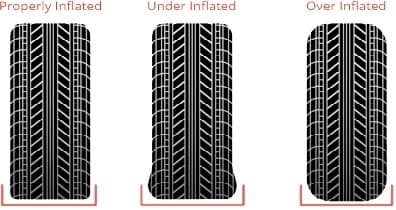
Tyres which are under-inflated will be too slack and will bulge at the bottom. This increases the risk of damage to the tyre, especially on the sidewall. If your tyre tread is wearing down faster on the edges of the tyre then you might have a problem with under-inflation.
Tyres which are over-inflated will be too rigid and will have a smaller contact area with the ground. This puts a lot of pressure on the middle of the tyre, wearing it down faster and making braking and handling much worse.
This graphic shows the shape of under- and over-inflated tyres compared to a tyre at the correct pressure. Car tyres are used in this example, but it also applies to other applications including tractor tyres, truck tyres, turf tyres and quad bike tyres.
For any vehicle that needs to pass an MOT there are very strict requirements for the minimum legal tread depth. To avoid trouble it is recommended to keep a close eye on car tyres once they reach 3mm, and to replace at 2mm remaining tread. If the tyre is not wearing down evenly then it could indicate that there is a problem:
For agricultural vehicles which are not used on the road there is no legal minimum tread depth, but badly worn tyres will perform poorly and are more vulnerable to punctures.
Tyre failure can occur as a result of wear, damage or ageing, and problems can often be avoided by regularly inspecting your tyres. At best, tyre failure will result in increased maintenance and avoidable down-time. At worst, tyre failure will result in serious injury or even death.
If your tyre is being used on the road at speed, then any damage to the tyre at all must be taken very seriously. Structural damage can not only mean that air will leak, it also increases the risk of sudden tyre failure and a serious accident. Tyres need to be carefully inspected for cuts, punctures, bulges and embedded objects. The rims and snap-in valves also need to be regularly checked for damage. If you find that you are having to top up the air pressure more often, this often means that there is a small puncture which could quickly turn into a large split. Although it is possible to repair high-speed tyres for commercial vehicles, passenger cars, trailers and similar, it is always far safer to purchase a new tyre. Damage to the sidewall should never be repaired: in this situation the tyre needs to be replaced immediately. An inner tube should never be used with a high-speed tubeless tyre, as again this creates a risk of sudden tyre failure.
For low-speed applications the risks are different, but tyre or wheel damage can still be dangerous. It is far more common however for tyre damage to result in costly down-time. It is important to store any spare tyres correctly, and to replace any tyres which are badly damaged, worn or perishing. Small punctures to the tread area can often be repaired, and for many applications it is safe to use an inner tube inside a low-speed tubeless tyre. If the cost of repairs and replacement tyres is getting prohibitive then it could be worth looking at tyre sealant, foam filling or even solid tyres depending on your application.
Polyurethane Foam Filling removes the need to constantly check air pressure, and makes tyres immune to normal punctures. These tyres will remain safe and stable when damaged, which is why foam filling is recommended for all access platforms and similar equipment. Foam-filled tyres should still be inspected for damage regularly, so that you can arrange for their replacements at a time to suit your schedule.